
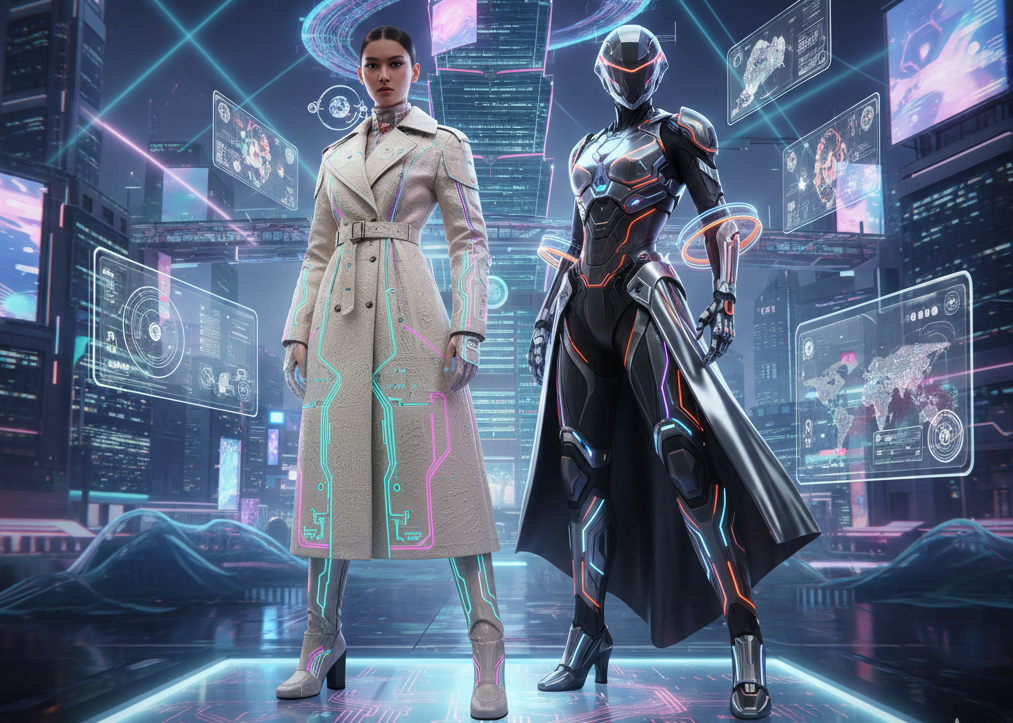
Insight: Designing Fashion For Social Gaming & Avatars
Designing Fashion for Social Gaming & Avatars: Where Identity, Utility, and Technology Converge
Editor’s Context — Digital Fashion Week
This insight is part of Digital Fashion Week’s ongoing research into how fashion technology, gaming, and emerging production systems are reshaping the global fashion industry. It reflects conversations shared on the Digital Fashion Week stage to help designers, brands, and technologists understand where real-world opportunity is forming inside virtual environments.
Digital fashion is no longer an experimental side quest. In social gaming environments, it has become a primary interface for identity, status, and value creation. As platforms like Roblox, Meta Horizon Worlds, and Snapchat evolve into persistent social spaces, fashion designers are being asked to think less like apparel makers—and more like systems designers.
This insight is drawn from a conversation between Jackie Barardo, Venture Capital Investor at Designer Fund, and Jana Delamarter, Staff Product Designer at Meta Reality Labs, whose work sits at the intersection of avatars, social gaming, and digital wearables. Their discussion offers a clear blueprint for how fashion, gaming, and emerging technology are converging—and where the real opportunities lie for designers and brands.
Fashion as Social Infrastructure in Gaming Worlds
In social gaming, fashion does not exist in isolation. It functions as social infrastructure.
Within Meta, this is often described through the concept of the social graph—the network of people you interact with, care about, and seek validation from. For Gen Z especially, this social graph increasingly lives inside digital environments. Social games are not just games; they are places to gather, hang out, perform identity, and be seen.
In these environments, the avatar becomes the primary social surface. What an avatar wears is not cosmetic—it is communicative. Clothing signals belonging, achievement, taste, creativity, and cultural literacy. When a digital item is rare, earned, or expressive within a shared context, it carries real social value.
This is why players—particularly younger audiences—are willing to invest time, money, and emotional energy into how their avatars look. Fashion in social gaming is not about realism first; it is about relevance to the community that inhabits that world.
Designing for Utility, Not Advertising
One of the clearest lessons from the conversation is what does not work.
Brands that simply replicate physical retail logic inside games—virtual storefronts, branded worlds, or static merch drops—are often perceived as intrusive advertising. Players are highly sensitive to being marketed to in spaces they consider social or playful.
What works instead is contextual utility.
Digital fashion succeeds when it is designed in collaboration with game mechanics and world logic. A branded garment that enhances gameplay—jumping higher, unlocking abilities, signaling status within the game—feels native rather than disruptive. In this model, branding becomes secondary to function, and value is created through use.
For designers, this requires a shift in mindset:
Designing with game designers, not around them
Understanding gameplay loops and player motivation
Treating garments as interactive systems, not static assets
This approach mirrors broader shifts in fashion technology, where garments—physical or digital—are increasingly embedded with function, data, and behavior.
A New Entry Point for Designers: Digital-First Creation
For emerging designers, social gaming offers a radically more accessible entry point than traditional fashion systems.
Instead of navigating manufacturing minimums, supply chains, or retail gatekeepers, designers can:
Learn 3D design tools
Create avatar-native garments
Publish directly to platforms with built-in audiences
Free or low-cost tools and creator ecosystems allow designers to prototype, distribute, and monetize digital fashion with unprecedented speed. More importantly, these platforms train designers to think spatially, systemically, and technologically—skills that are increasingly critical across the fashion industry.
Digital fashion creation is not a replacement for physical fashion expertise; it is an adjacent discipline that feeds directly into the future of manufacturing, virtual prototyping, and AI-assisted design.
Avatars as the Bridge Between Digital and Physical Fashion
Avatars are no longer novelty representations. They are becoming embodied interfaces.
When users can inhabit an avatar—especially in VR or mixed reality—the emotional stakes change. Seeing yourself move, gesture, and interact while wearing a digital garment creates a sense of presence that flat images cannot replicate. As embodiment increases, so does willingness to pay for quality, fit, and self-expression.
The next major shift is toward realistic, dimensionally accurate avatars. As avatar fidelity improves, the boundary between digital fashion and physical fashion begins to dissolve:
Designers can prototype garments on realistic bodies
Consumers can try on clothing virtually with confidence
Digital assets can flow directly into manufacturing workflows
This convergence directly supports advancements in fashion technology for manufacturing, where 3D garments, digital twins, and AI-driven simulation are reducing waste, accelerating development, and improving fit accuracy.
Virtual Try-On, AI, and the Future of Fit
One of the most transformative opportunities discussed is virtual try-on.
The long-standing friction in e-commerce—uncertainty around fit, drape, and material behavior—can be addressed when two systems mature simultaneously:
Accurate digital representations of garments (patterns, materials, physics)
Personalized avatars that reflect real human bodies
AI plays a critical role in bridging these systems. Trained on garment construction data, materials, and body measurements, AI can simulate how clothing behaves across bodies at scale. This is not speculative—it is an extension of tools already used in digital sampling and manufacturing.
For brands, this unlocks:
Higher conversion rates
Lower return rates
Access to global customers without physical retail
For designers, it creates a future where digital design is not separate from physical production, but foundational to it.
Creativity, AI, and Perceived Value
A recurring concern in digital fashion is whether AI-generated content undermines creative value.
The reality emerging across platforms is more nuanced. Most creators already use AI as part of their workflow—for ideation, iteration, or acceleration—while maintaining a distinct creative voice. What audiences value is not the absence of AI, but the presence of authorship.
In digital fashion, value is tied to:
The creator’s identity and story
A recognizable aesthetic or design language
The cultural meaning attached to the item
Even in environments where users can generate their own garments, creator-led pieces retain value because they carry social and cultural context that automation alone cannot replicate.
Why This Matters Now
Social gaming is not a niche channel—it is a proving ground for the future of fashion technology.
The same systems that power avatar fashion—3D design, digital identity, AI simulation, virtual try-on—are reshaping how fashion is designed, manufactured, marketed, and monetized globally.
For designers, founders, and brands, the opportunity is not simply to "enter the metaverse," but to:
Learn how digital fashion systems work
Design for identity and interaction, not just aesthetics
Build skills that translate directly into next-generation manufacturing and AI-driven workflows
Fashion for social gaming is not separate from the fashion industry’s future. It is one of the clearest signals of where that future is being built—right now.