
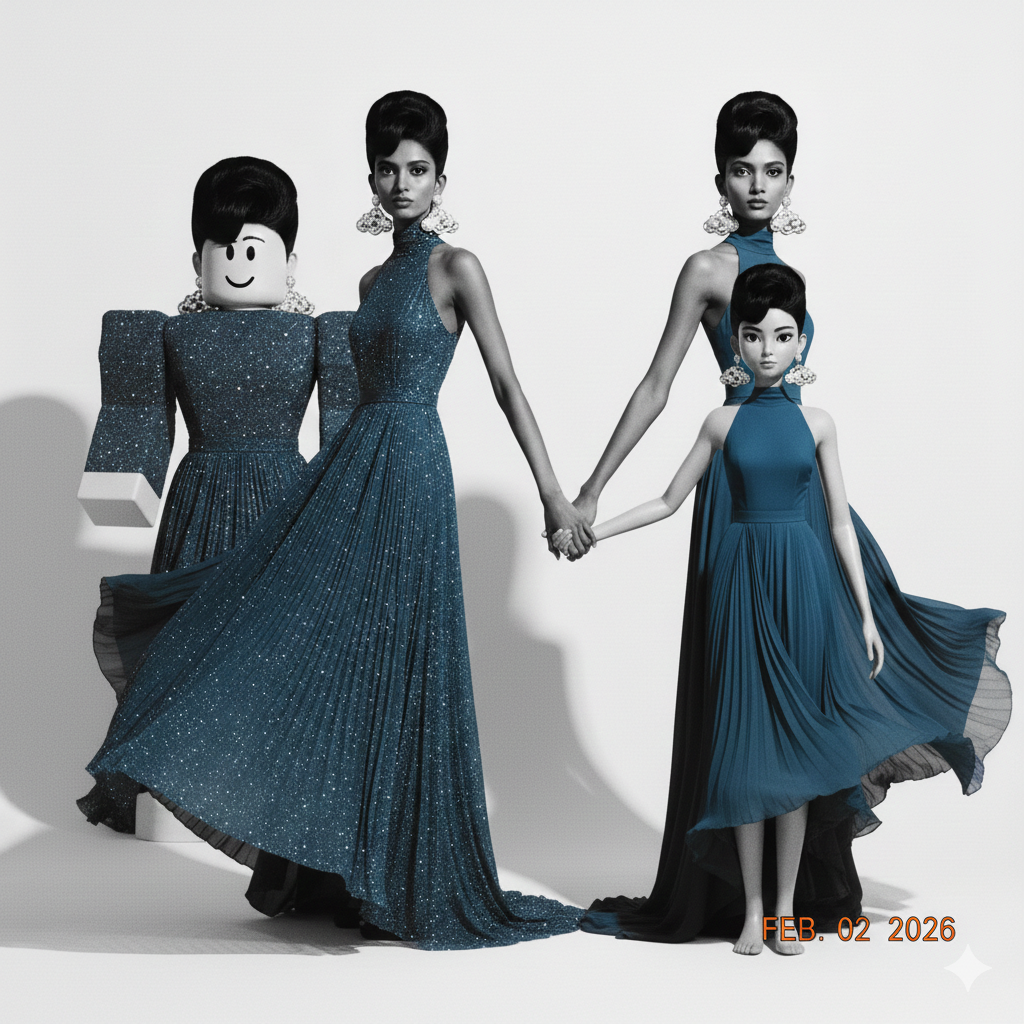
Insight: From Avatar Design To Physical Manufacturing
.
From Avatar Design to Physical Manufacturing: How Digital Fashion Becomes Real
Digital fashion is often framed as a parallel universe—creative, expressive, and detached from the realities of manufacturing. In practice, the opposite is happening. The same tools and systems used to design clothing for avatars are rapidly becoming foundational to how physical garments are conceived, tested, and produced.
This insight connects the worlds of social gaming, avatars, and virtual fashion to the evolution of fashion manufacturing—showing how digital-first design is not replacing physical fashion, but quietly rebuilding its infrastructure.
Avatars as the New Fit Model
For decades, fashion has relied on abstracted size charts, standardized fit models, and physical sampling to approximate how garments will behave on real bodies. Avatars introduce a fundamentally different paradigm.
As avatars become more realistic—dimensionally accurate, animated, and personalized—they begin to function as digital fit models. Designers can test proportion, drape, and silhouette before a single physical sample is cut. This reduces both uncertainty and waste while accelerating development timelines.
What begins in gaming and virtual worlds—designing clothing for embodied avatars—directly informs how brands prototype garments for real humans.
“These shifts sit within the broader evolution of fashion technology,
where digital tools, AI systems, and 3D workflows are redefining
how fashion is designed, produced, and experienced globally.”
3D Garments as the Common Language
One of the most important shifts underway is the rise of the 3D garment as a shared technical asset.
In avatar platforms, garments must be designed in three dimensions to move correctly with a body. In manufacturing, the same requirement exists—but with added constraints of material physics, construction logic, and cost.
When designers work natively in 3D:
Patterns become data
Materials become simulatable
Fit becomes testable before production
This convergence allows a single digital garment to travel across contexts—from social gaming skins to virtual try-on to factory-ready specifications.
Virtual Try-On as a Manufacturing Breakthrough
Virtual try-on is often discussed as a consumer-facing experience, but its deeper impact lies upstream.
To support accurate try-on, brands must create high-fidelity digital versions of their garments, complete with construction details and material behavior. These assets are the same ones needed to:
Reduce physical sampling
Improve first-sample accuracy
Enable on-demand or localized manufacturing
When paired with realistic avatars, virtual try-on systems transform uncertainty into measurable data—reshaping how fashion companies make decisions long before garments reach consumers.
“As avatars become more realistic and embodied, they increasingly function as part of the same pipeline described in fashion technology for manufacturing, where digital garments, simulation, and virtual prototyping are already transforming physical production.”
AI as the Bridge Between Design and Production
Agentic and assistive AI systems are increasingly capable of interpreting fashion’s most complex inputs: patterns, tech packs, grading rules, and material properties.
Trained on this data, AI can:
Predict fit outcomes across body types
Simulate fabric behavior at scale
Optimize construction for speed, cost, or sustainability
What matters is not that AI replaces designers or technicians, but that it absorbs repetitive analysis—freeing humans to focus on creative direction, craftsmanship, and innovation.
The same AI systems used to accelerate digital fashion creation in virtual worlds are now being adapted to industrial workflows.
“The progression from avatar design to real-world production is explored further in From Avatar Design to Physical Manufacturing, which examines how digital-first fashion systems are quietly rebuilding the industry’s infrastructure.”
Why Gaming Worlds Matter to Manufacturing
Social gaming environments act as live laboratories for digital fashion systems.
In these worlds:
Garments must function on moving bodies
Identity and self-expression drive adoption
Scale and speed expose technical weaknesses quickly
Solutions that succeed in gaming—robust 3D pipelines, efficient asset reuse, real-time simulation—are precisely the capabilities manufacturing needs to modernize.
Rather than viewing gaming fashion as separate or frivolous, forward-thinking brands are treating it as an R&D environment for next-generation production.
Closing the Digital–Physical Loop
The future of fashion is not digital or physical. It is digital to physical.
Designers who learn to create for avatars gain fluency in the tools that increasingly define manufacturing. Brands that invest in digital garments unlock efficiency, sustainability, and new revenue models. Consumers gain confidence, personalization, and access.
Avatar design is not the end point—it is the beginning of a more intelligent, connected fashion system.
This is the loop Digital Fashion Week exists to illuminate: where creativity, technology, and production meet—and where the next era of fashion is being built.