
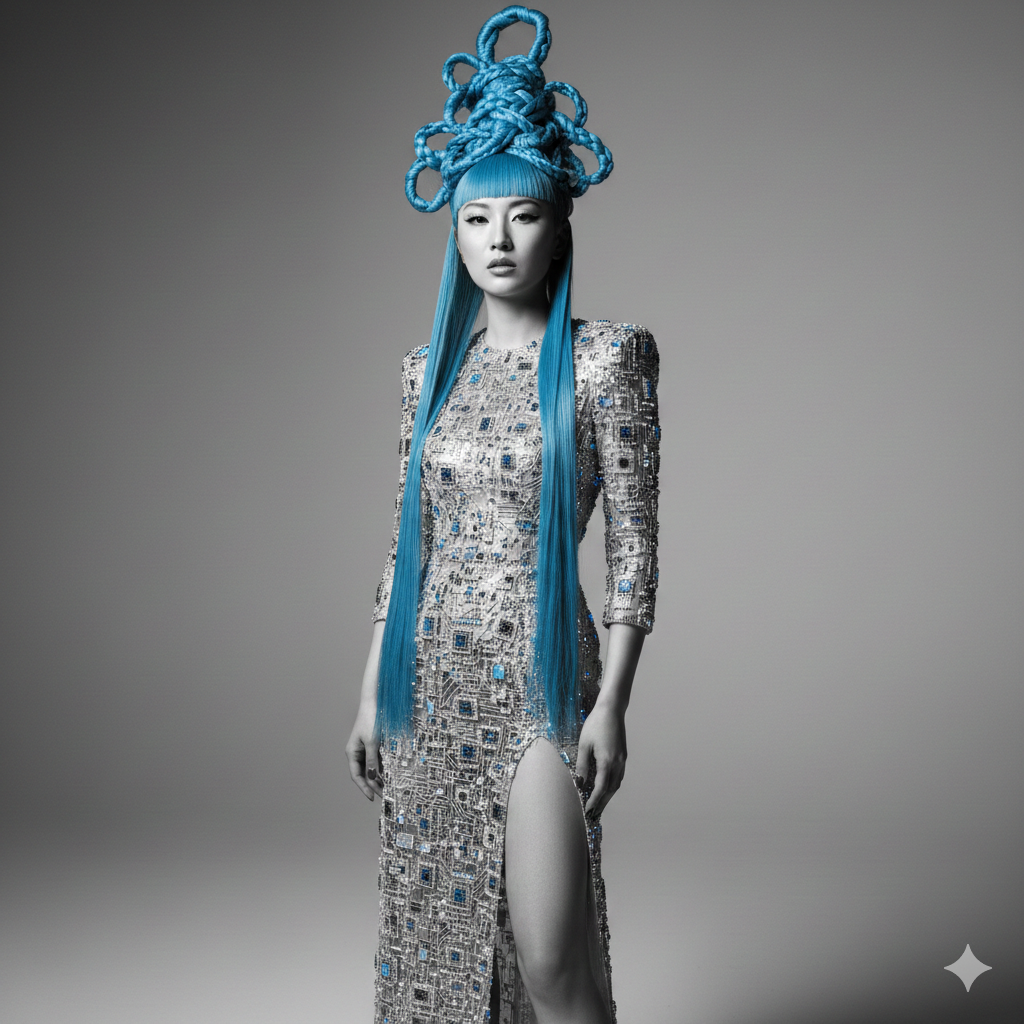
From Automation to Agency: How Fashion Creators Are Building Digital Ambassadors
Insight from a Digital Fashion Week Masterclass Series
Fashion technology is entering a new phase. Not defined by tools alone, but by agency: systems that remember, reason, observe, and act on behalf of their creators. This Insight synthesizes a three-part Digital Fashion Week masterclass led by Astrid Pilla and shows how agentic AI is already reshaping creative, brand, and operational workflows — long before full industrial-scale deployment.
The Shift: From Doing More to Delegating Better
The masterclass opened with a blunt reframing: you are the bottleneck. Not because of lack of talent, but because human attention does not scale. AI’s earliest value in fashion is not spectacle — it is relief.
Day One focused on automation as the foundation layer of fashion technology adoption. Participants were guided to audit their daily workflows and separate tasks that require human judgment from those that can be delegated to systems. Calendar management, content formatting, research aggregation, posting, and data movement were reframed as non-creative labor — essential, but no longer human-bound.
This distinction matters. Automation is not about speed for its own sake; it is about reclaiming cognitive space so creative and strategic work can actually happen. In manufacturing terms, this is the equivalent of removing friction from a production line before introducing intelligence.
Automation, however, is only the entry point.
Encoding Taste: When Brand Voice Becomes a System
Day Two moved from delegation to amplification.
Once repetitive work is cleared, the next question emerges: How does AI create without diluting identity? The answer presented was not better prompts, but better structure.
Participants translated their creative voice — tone, taste, references, constraints — into reusable frameworks. These documents functioned as living brand DNA: instructions that AI systems could retain, reference, and apply consistently across outputs.
This marked a critical transition from using AI as a tool to treating it as a collaborator. The systems were no longer generating content in isolation; they were operating within defined aesthetic and strategic boundaries.
In fashion technology terms, this mirrors what is happening in advanced manufacturing: intelligence is only useful when it understands context. A machine that knows how to cut fabric is not the same as one that understands waste tolerance, material behavior, and brand standards.
Taste, once implicit, becomes explicit — and therefore scalable.
Digital Ambassadors: The Emergence of Social Agents
Day Three introduced the most visible expression of agentic AI: the digital ambassador.
Participants explored the difference between digital twins (replicas of real people used to extend personal authority) and digital ambassadors (distinct personas designed to operate autonomously on behalf of a brand). While twins preserve identity, ambassadors expand it.
Using platforms such as Pendium AI and Higgsfield, Astrid demonstrated how social agents can:
Maintain awareness of context (events, locations, audiences)
Observe visual and environmental inputs
Generate posts, images, and responses aligned with brand DNA
Interact live with audiences while respecting predefined behavioral rules
One ambassador, active across X, Instagram, and Pinterest, had been operating autonomously for nearly a year — posting, responding, generating memes, and engaging with fashion discourse without constant human intervention.
This is not automation. It is delegated presence.
Why This Matters for Fashion Technology
The systems demonstrated in this masterclass reveal how agentic AI will enter fashion not as a replacement for human creativity, but as infrastructure.
Three implications stand out:
1. Agency Scales Faster Than Headcount
Digital ambassadors and social agents allow brands to maintain always-on presence without proportional labor increases. This mirrors how intelligent systems are being introduced in manufacturing: fewer handoffs, fewer bottlenecks, higher continuity.
2. Vision Is Becoming Machine-Readable
From brand DNA documents to memory modules and knowledge bases, fashion intelligence is being encoded. This same logic underpins smart factories, predictive production planning, and adaptive supply chains.
3. Trust Is Built Through Constraints
The most effective agents were not the most expressive — they were the most bounded. Clear rules around tone, behavior, and escalation made autonomy safe. This principle applies equally to creative systems and production environments.
Agentic AI Is Not the Future — It Is the Interface
What this masterclass made clear is that agentic AI is already operational in fashion ecosystems. Not as a monolithic system, but as a network of specialized agents handling discrete responsibilities.
The leap from automation to agency is not about complexity. It is about mindset.
Fashion technology is no longer defined solely by software or hardware. It is defined by how intelligently we decide what to delegate, what to encode, and where human judgment still matters most.
The brands and creators who understand this shift will not just move faster — they will operate differently.
That is the real transformation underway.