
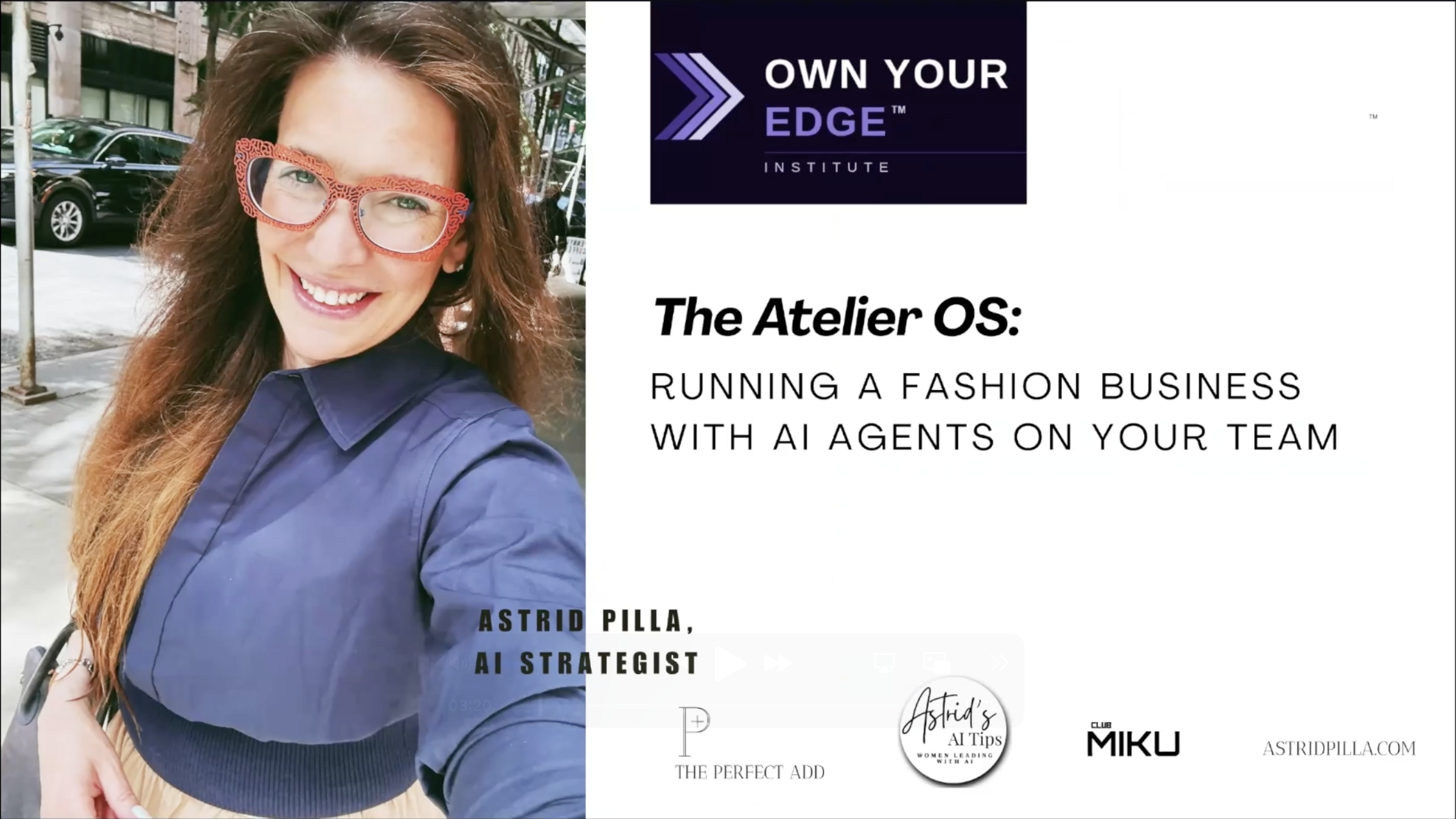
The Executive Summary: How AI Agents Can Transform Your Fashion Business
WATCH THE RECORDING HERE
Thank you for joining our Summer Series Masterclass on AI Agents for Fashion WITH ASTRID PILLA. The session explored one of the most important shifts happening in business today: moving beyond simple AI tools and beginning to build AI-powered teams that can support, automate, and scale creative and operational work.
The Big Idea: Think Beyond Chat
Most people use AI as a chatbot. The next evolution is using AI agents—specialized digital assistants that can understand your brand, learn your preferences, and help execute real business tasks.
Instead of asking AI a single question, imagine having:
A Creative Director Agent
A Stylist Agent
A Copywriting Agent
A Buyer Agent
An Inventory Agent
A Customer Service Agent
All working together as an extension of your team.
For fashion businesses, this creates opportunities to increase output, reduce repetitive work, and focus more time on creativity and growth.
Four Levels of AI Adoption
The masterclass highlighted a progression that many businesses will follow:
1. AI Chat Tools
Simple question-and-answer tools such as ChatGPT, Claude, Gemini, or Perplexity.
Best for:
Brainstorming
Research
Writing assistance
Content creation
2. AI Inside Existing Software
AI features built into platforms such as CRM systems, marketing tools, email platforms, and workflow software.
Best for:
Customer service
Marketing automation
Administrative tasks
3. Brand-Trained AI Agents
AI assistants that learn your brand identity, tone of voice, design aesthetic, collections, customers, and workflows.
Best for:
Lookbooks
Campaign development
Product descriptions
Collection storytelling
Brand consistency
4. Agent Teams
Multiple AI agents working together under one system, each assigned a specialist role.
Best for:
End-to-end project management
Collection development
Marketing execution
Website management
Customer engagement
This is where the industry is rapidly heading.
Practical Fashion Use Cases
Create Lookbooks Faster
By providing a mood board, brand information, imagery, and design preferences, AI can generate:
Collection narratives
Lookbook copy
Styling suggestions
Color stories
Product descriptions
The more the system learns your aesthetic, the more consistent the outputs become.
Build a Living Brand Book
New AI tools can analyze your website and existing assets to generate:
Brand guidelines
Campaign concepts
Website drafts
Marketing materials
Customer-facing experiences
This allows emerging brands to access capabilities previously reserved for large creative teams.
Launch Websites and Digital Experiences
AI can help create:
Brand websites
Client portals
Community spaces
E-commerce experiences
Customer support assistants
Many founders are now building digital products and tools without traditional coding experience.
Improve Customer Service
AI agents can:
Answer product questions
Track inventory
Guide customers through purchases
Provide styling recommendations
Handle routine inquiries
This creates a more responsive customer experience while reducing workload.
You Do Not Need to Be a Developer
One of the strongest messages from the session was that technical expertise is no longer the primary barrier.
The most valuable skill is curiosity.
Successful AI users ask:
"Can this process be improved?"
"What am I missing?"
"Is there a better way to do this?"
"Can AI help solve this problem?"
Modern AI systems can explain technical concepts, guide implementation, and help troubleshoot challenges using natural language.
Trust, But Verify
AI is a powerful collaborator, but it should not operate without oversight.
Always:
Review outputs carefully
Verify important information
Compare recommendations across different AI models
Maintain brand and creative direction
Prioritize privacy and security
The most effective approach is partnership, not blind automation.
What Fashion Leaders Should Do Next
Start small.
Choose one repetitive process that consumes valuable time and experiment with AI support.
Good starting points include:
Writing product descriptions
Creating social content
Developing lookbooks
Organizing customer data
Researching trends
Planning campaigns
The brands that begin learning today will have a significant advantage as AI agents become a standard part of creative and business operations.
Looking Ahead
The future of AI is becoming increasingly personal.
Rather than using generic tools, businesses will train AI systems that understand their unique brand, customers, values, aesthetic, and goals.
For fashion brands, this means the possibility of scaling creativity, improving efficiency, and delivering highly personalized customer experiences—without dramatically increasing team size.
The opportunity is not to replace human creativity.
The opportunity is to amplify it.